
AI is Everywhere.
Competitive Advantage is Not.
Jonathan Trevor - March 2026
Most organisations are investing heavily in AI. Far fewer are thinking strategically about where it actually belongs.
AI is everywhere, but competitive advantage is not. The problem is not adoption. It is misalignment.
Too many organisations are treating AI as a strategy, a capability - even, in some cases, a purpose. It is none of these things.
AI is a resource. And like any resource, it only creates value when it is aligned across the enterprise, from purpose and strategy through to capabilities, architecture, and systems.
Without that alignment, even the most sophisticated AI will struggle to deliver meaningful strategic impact.
In my latest article, I explore why this distinction matters and offer provocations as to why so many AI initiatives fail to translate into real competitive advantage.
So where does AI actually belong in your enterprise?
AI Is Everywhere. Competitive Advantage Is Not.
Last week, I led a session on strategic alignment for a group of fifteen blue-chip CIOs and CTOs, brought together by Amazon Web Services in partnership with the University of Oxford's Saïd Business School. I posed a deceptively simple question that sparked a lively debate: where does AI actually sit in the enterprise?
The question matters more than it first appears. Because while AI is rapidly becoming ubiquitous across organizations (nearly nine out of ten respondents say their organizations are regularly using AI, according to McKinsey), competitive advantage is not. A global study of 2,000 CEOs by the IBM Institute for Business Value found that only about one in four AI initiatives has delivered the expected return on investment, and only 16% of projects have scaled across the enterprise.
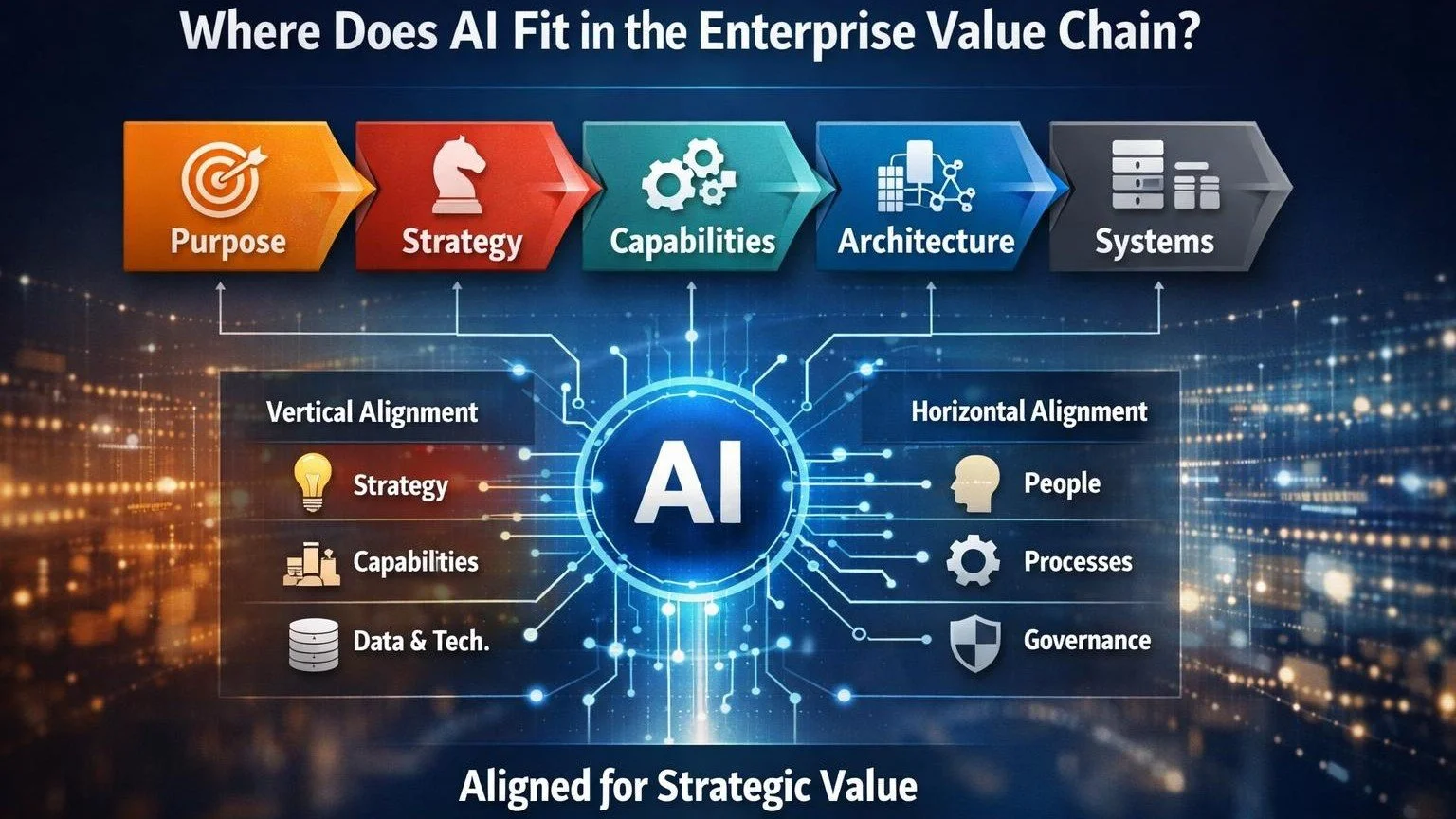
In other words, AI is everywhere — but strategic value remains elusive. Part of the reason, I suspect, is that many organisations have not yet worked out where AI actually belongs within the enterprise's logic. In the Enterprise Value Chain framework I use in my work on alignment, the links run broadly as follows[i]:
Enterprise Purpose → Business Strategy → Organizational Capabilities → Organizational Architecture → Management Systems
For more info on the value chain, see an earlier Harvard Business Review article.
Each link of the value chain informs the next, but each link is also enabled by what follows. And the value chain is only as strong as its weakest link.
Its purpose defines why the organization exists.
Its strategy defines where and how it will compete.
Its capabilities enable that strategy.
Its architecture supports the development of those capabilities.
Its systems support their mobilisation operationally.
So the question becomes: Where does AI belong in this chain? The discussion with the CIOs and CTOs led to several useful conclusions.
AI cannot be the purpose of an enterprise
Businesses do not exist to have AI. They exist to create value for customers and society. AI, like capital, infrastructure, or human talent, is something organisations may deploy in pursuit of that purpose.
Yet much of the rhetoric around AI sometimes suggests otherwise. Companies talk about “becoming an AI company” as if the technology itself were the destination. But AI is a means to an end, never the end itself.
In other words, just as companies do not exist solely to employ people but employ people to exist, companies do not exist to use AI; they may utilise AI to survive and flourish.
AI is not a strategy
Strategy is about choices. It defines where an organization will compete and how it intends to win. It determines markets, value propositions, positioning, and the distinctive activities that differentiate one firm from another. AI may influence how those strategies are executed — but it is not the substance of strategy itself. A strategy cannot simply be: “Use AI.”
That would be like saying the strategy is “hire people”. Both may be necessary. Neither is sufficient.
Nor is AI an organizational capability
Capabilities emerge from the integration of multiple resources. They arise from the coordinated deployment of people, processes, culture, data, technology, and governance systems
AI may enhance these elements, but it does not constitute a capability in itself. Possessing an algorithm is not the same as possessing an organizational capability. Organizational capabilities — also known as core competencies — emerge when resources are combined and orchestrated effectively.
AI is a resource
The most useful way to think about AI is therefore as a resource. Like human expertise, organizational processes, or digital infrastructure, AI is something firms can invest in and deploy. But resources only create value when they are aligned and integrated. This is where many AI initiatives run into difficulty.
Technology does not create advantage. Aligned systems do.
The alignment challenge
For AI to create real strategic value, it must be aligned in two ways.
Vertical alignment: First, AI investments must be aligned vertically within the enterprise value chain. AI should support the organization’s strategy, which in turn should reflect its purpose. Those investments must then be embedded in capabilities and supported by appropriate enterprise architectures, data platforms, and operational systems. Without this vertical alignment, AI becomes simply another disconnected technology layer.
Horizontal alignment: Second, AI must be aligned horizontally with other organizational resources. AI systems do not operate in isolation. They must integrate with human expertise, operational processes, organizational routines, data governance, digital infrastructure, and decision systems.
In practical terms, this means embedding AI within the enterprise technology stack — from data pipelines and model training environments to deployment infrastructure and workflow integration.
Without this integration, even technically impressive models struggle to produce meaningful organisational impact.
The efficiency trap
Much of the current AI conversation focuses on efficiency. Automation. Productivity gains. Cost reduction. “10x output”. These improvements are attractive. But they also reveal a limitation.
Efficiency gains often produce diminishing returns. Once a process has been optimised, further improvements become progressively smaller. This may help explain why so many AI initiatives struggle to deliver meaningful financial results.
Technology alone rarely produces strategic value. It must be integrated into the system of capabilities that allows the organization to function.
Efficiency improves short-term performance. It rarely affects competitive differentiation.
Form follows function
Another complication is that “AI” is an extremely broad category. Different forms of AI serve very different purposes. For example:
Predictive AI supports forecasting and decision-making.
Generative AI augments knowledge work and content creation.
Agentic AI systems coordinate tasks and workflows across multiple tools and datasets
Each of these technologies sits at different points in the enterprise architecture and supports different organizational functions. In other words, form should follow function.
AI should be designed and deployed in response to specific strategic and operational needs — not simply adopted because it is the latest technological wave.
Strategically aligned AI
If AI is not the enterprise’s purpose, strategy, or capability, what role should it ultimately play?
Its true potential lies in enabling organisations to become distinctively capable of executing their strategy in ways that were previously impossible. This is where AI moves beyond efficiency and becomes a source of innovation. Not by simply doing the same things faster or cheaper.
But by enabling firms to operate differently:
solving problems that competitors cannot
serving customers in new ways
scaling capabilities that were previously constrained by human limitations.
In short, AI becomes powerful when it is strategically aligned. But as we know, strategic alignment is tough. In my most recent Harvard Business Review article, 91% of management level respondents agreed that strategic alignment is important (in performance terms), but only 14% strongly agreed they were aligned.[ii]
This is not a theoretical concern. IBM’s Watson Health, for example, demonstrated significant technical capability, yet struggled to integrate into clinical workflows and decision processes — ultimately limiting its impact.
The leadership question
The implications for leaders are significant. The real challenge is not simply adopting AI or experimenting with new tools, for which there is an abundance of consultants and platforms willing to help.
It is ensuring that AI investments are strategically aligned with the organisation’s purpose, strategy and capabilities, and integrated with the broader system of people, processes and technologies that enable the enterprise to function. Only then can AI help organizations become truly distinctive.
Which leads to a final question.
As organisations invest billions in artificial intelligence: Are leaders thinking strategically about the role AI should play in the enterprise? Or are they simply jumping on the latest technological bandwagon?
REFERENCES
[i] Trevor, J. & Varcoe, B., (2017). How aligned is your organization? Harvard Business Review. 7 February. Harvard Business School Publishing.
[ii] Trevor, J., (2026). What Leaders Get Wrong About Strategic Alignment? Harvard Business Review. 14 January. Harvard Business School Publishing.