
Strategic alignment is one of the strongest predictors of organisational performance.
Strategic alignment refers to how well an enterprise’s purpose, strategy, capabilities, structure, and systems work together as a unified whole to achieve its long-term purpose.
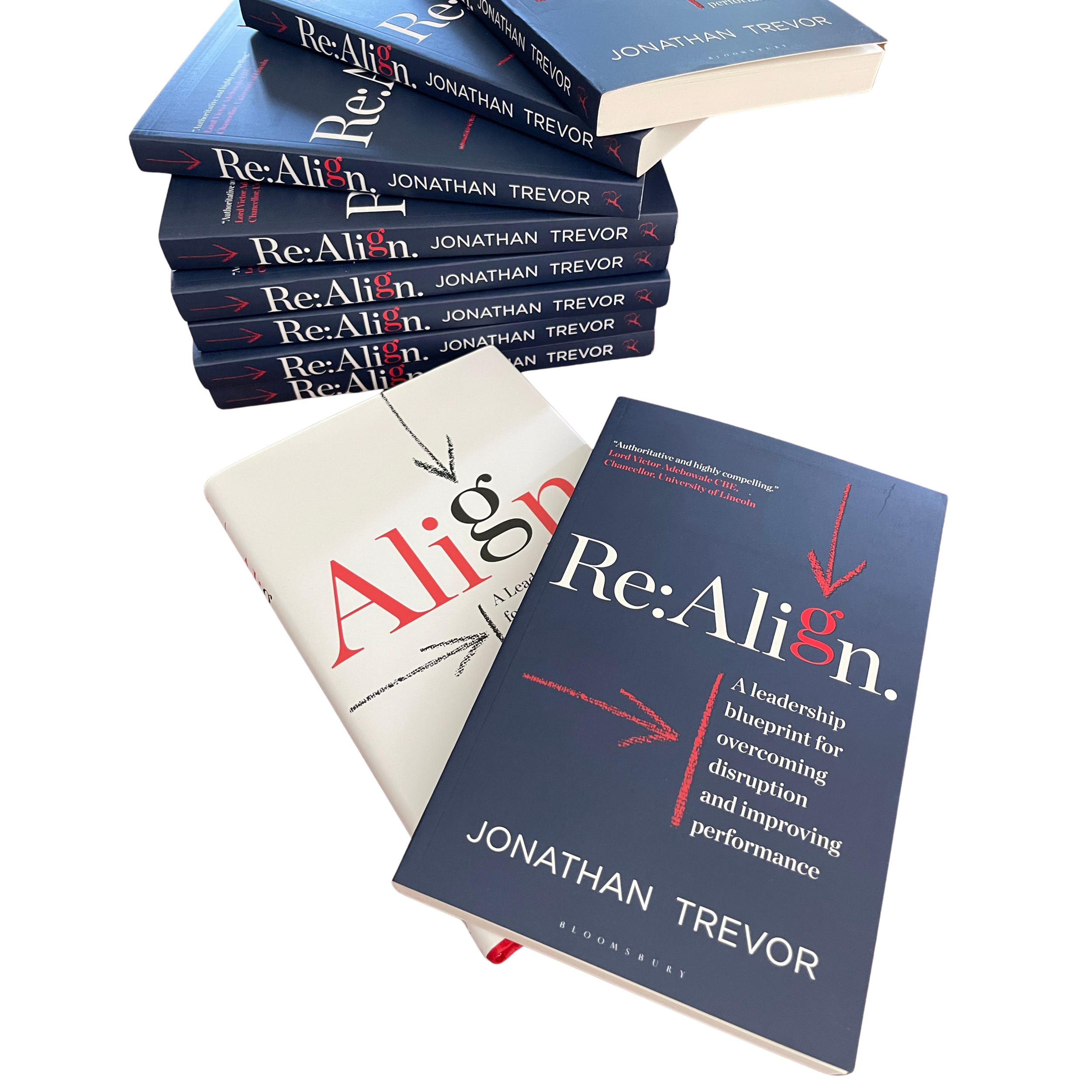
Jonathan Trevor is one of the clearest thinkers on organisational alignment I have encountered. His work, including Re:Align, captures something many leadership teams intuit but often struggle to implement. Jonathan combines deep academic rigor with a pragmatic understanding of how complex enterprises function. His framework gives leaders practical ways to diagnose misalignment, clarify priorities, and ensure strategy, structure, and execution move in concert.
“
Martyn Etherington
Chief Marketing Officer, BMC Software
Leadership Alignment
# 1 predictor of strategic alignment 1.8x stronger than the next factor

Only 14% strongly believe their organisations are strategically aligned
2× higher organisational performance
Strategic Alignment

Organisational Performance
2.4× target achievement
2× budget delivery
2× on-time delivery
*Oxford Strategic Alignment Survey 2024
Why does strategic alignment matter?
Strategic alignment is not simply about aligning people behind a strategy.
It is about ensuring that every part of the enterprise — from market strategy to technology investments to HR systems — reinforces the others.
Strategically aligned enterprises are more than twice as likely to achieve their financial targets and to outperform the industry average as their poorly aligned peers.
Strategic alignment enables organisations to:
sustain superior organisational performance
execute strategy consistently
make faster, better enterprise decisions
coordinate effectively across organisational boundaries
adapt confidently to change and disruption
translate leadership intent into enterprise-wide action
Organisations are only as aligned as their leadership.
Strategic alignment does not occur naturally or by accident.
It emerges when disciplined leadership teams work together to clarify strategic intent, resolve critical trade-offs and align on the choices that matter most.
This means:
A shared understanding of what the organisation is trying to achieve
Making decisions from a shared frame of reference
Ensuring organisational choices reinforce strategic intent consistently
Concentrating resources behind the priorities that matter most
91% of executives agree that strategic alignment is a critical driver of business success. Yet fewer than one in seven strongly agree that their organisation is aligned. In other words, many leaders recognise the problem — but can’t seem to solve it.
How misalignment undermines performance

-
Leaders and teams work from different understandings of what matters most.
-
Trade-offs remain unresolved and important decisions take longer than they should.
-
Functions and business units optimise locally rather than for the enterprise.
-
o The organisation is not designed to reinforce strategic intent consistently.
-
Resources and effort are spread too thinly to create meaningful advantage.
-
Execution varies across the enterprise, and performance becomes difficult to sustain.
Start a conversation about your leadership alignment challenge
If strategy is not translating into results, decisions feel slower than they should, execution is inconsistent, or your organisation feels fragmented despite everyone’s best efforts, the underlying issue is often a lack of leadership alignment.
If that sounds familiar, I’d be delighted to start a conversation.